Easter Island Statue Project Official Website
Publications

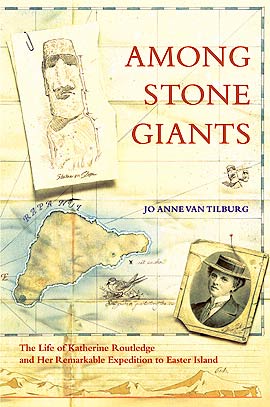
Among Stone Giants: The Life of Katherine Routledge and Her Remarkable Expedition to Easter Island

Among Stone Giants by Jo Anne Van Tilburgby Jo Anne Van Tilburg

“The archaeologist Jo Anne Van Tilburg’s Among Stone Giants is a copiously researched biography of Katherine Routledge…In Van Tilburg’s hands, Routledge is as striking an enigma as the island she studied….there’s more than enough drama to be had [in Routledge’s] admirable achievements and poignant setbacks. Van Tilburg’s background as an archaeologist and her long familiarity with Easter Island prove essential to her understanding of the Routledges’ accomplishments….”
—The New York Times Book Review, June 17, 2003

Hardcover, 368 pages
16 pages of photographs
ISBN: 0-743-24480-X
Order a signed copy from EISP: $20

Book Website

Posted on May 6th, 2009 by EISP Staff | Categories: Publications |

Remote Possibilities: Hoa Hakananai’a and HMS Topaze on Rapa Nui

by Jo Anne Van Tilburg with drawings by Cristián Arévalo Pakarati

British Museum Research Publication no. 158.
October 2005

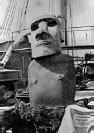
Hoa Hakananai'a on board HMS Topaze, Portsmouth, 1869.

Hoa Hakananai'a on board HMS Topaze, Portsmouth, 1869.

In 1868, Hoa Hakananai’a was discovered on Rapa Nui (Easter Island), Polynesia. From there it was shipped to England on board HMS Topaze, and then offered to Queen Victoria who presented it to the British Museum. It is not known precisely when this basalt figure was carved, but nearly one thousand moai were produced – all sacred icons exemplifying the Polynesian concern with ancestry, the gods, life and death. This volume describes how, when and by whom Hoa Hakananai’a was collected. It reconstructs the underlying Rapanui aesthetic and social structure that produced Hoa Hakananai’a, and which has been obscured by time and historic accident. The research framework that supports the text includes: the cultural context discerned in the analysis of objective descriptive data collected from nearly 1,000 moai and set within the broader revelations of modern archaeology, geography and ecology; the anthropological insight gained from two decades of valuable ethnographic contact with a broad representation of the Rapanui community, and the evident aesthetic congruence and continuity discerned in certain classes of Rapanui objects, in addition to moai, held in museum collections throughout the world. Many of the illustrations in this paper are published here for the first time.

A4, 80 pages of text, including over 50 halftones, 10 pages of colour illustrations, and 20 detailed line drawings, perfect bound, laminated cover.

ISBN 086159 158 5
ISSN 0142 4815

Available from:
David Brown Book Co.
British Museum Store

Posted on May 6th, 2009 by EISP Staff | Categories: Publications |

Recording, Documentation, and Information Management for the Conservation of Heritage Places

Volume II: Illustrated Examples

Edited by Rand Eppich and Amel Chabbi
Los Angeles: The Getty Conservation Institute, 2007.

Recording, Documentation, and Information Management for the Conservation of Heritage Places. Volume II: Illustrated Examples

Mapping Features

by Jo Anne Van Tilburg, Cristián Arévalo Pakarati, and Alice Hom
in Section 2: Base Recording: Gathering Information. Pages 31–36. [pdf, 8.9MB]

EISP contributed a case study on GPS mapping of features in Rano Raraku Quarry to this handbook of documentation techniques.

Main publication page: The Getty Conservation Institute

Posted on May 4th, 2009 by EISP Staff | Categories: Publications |

EISP Publications Order Form

All proceeds from direct book sales benefit UCLA Rock Art Archives and Easter Island Statue Project. [Read More...]

Posted on April 30th, 2009 by EISP Staff | Categories: Publications |

Easter Island: Archaeology, Ecology, and Culture

by Jo Anne Van Tilburg
Foreword by John Mack
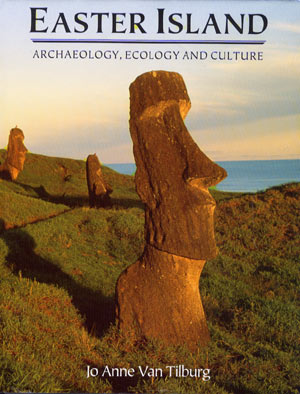
Easter Island book cover

Hardcover, 232 pages
30 color and 124 B&W illustrations
Smithsonian Press (October 1995)
Order a signed copy from EISP: $25

Since Easter Island (Rapa Nui) was first “discovered” nearly 300 years ago, its people, culture and monolithic statues have been seen as an unsolvable riddle. At the heart of the so-called mystery stand the gigantic moai. How were they moved? What do they mean? Over more than twelve years, nearly 1000 statues have been measured, drawn and photgraphed by Jo Anne Van Tilburg and a team of colleagues. In this ground-breaking title, the author draws on the insights that have been gained, to examine Rapa Nui prehistory in the context of new understandings of ecology and culture.

Posted on April 17th, 2009 by EISP Staff | Categories: Publications, Recent News & Links |